


By Linus Obogo
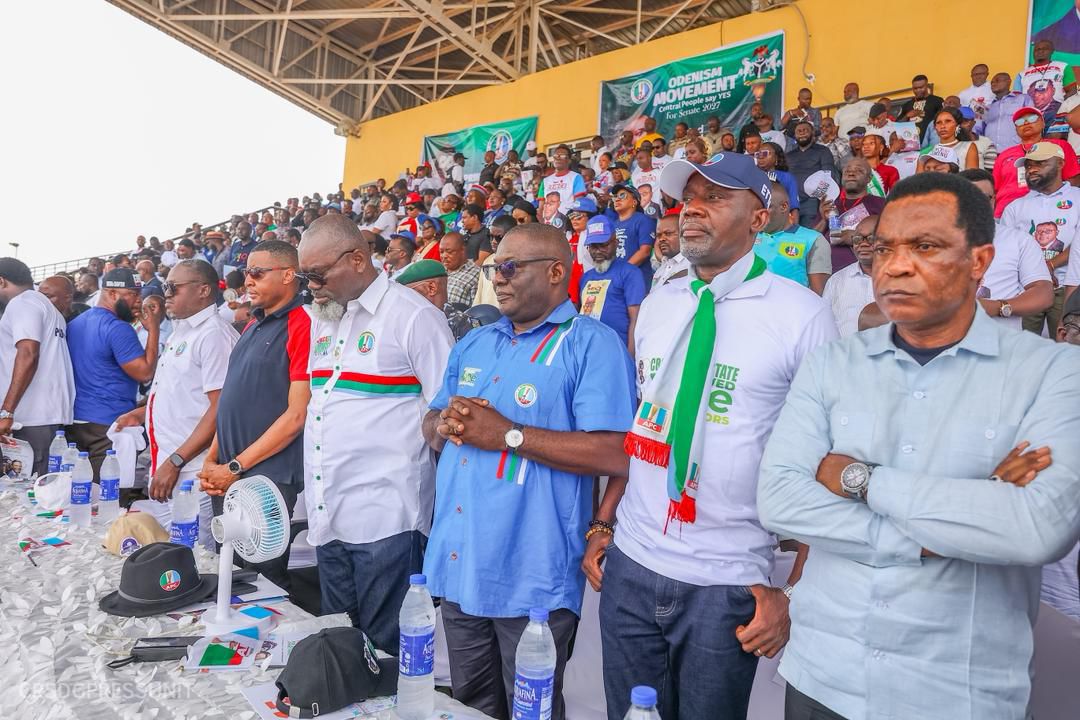
As early as 7:00 a.m, on Saturday, April 18, the smiling sun rose gently and in expectancy over the horizon, casting its golden warmth across the waking earth of Ikom Township Stadium, with the clock inching toward the 2:00 p.m. take off time for the 1.5 million-man endorsement rally for President Bola Ahmed Tinubu cum Governor Bassey Otu/ Peter Odey’s second term.
At exactly 2:p.m, the sound of the state song and the National Anthem wafted through the public address system indicating the transformation of the arena into a living, breathing tapestry of colour and conviction, banners fluttering like restless birds, drums speaking in ancestral rhythms, and chants rising in synchronized waves.
From the 196 political wards and all 18 local government councils, a vast concourse of an unbroken procession of loyalty and purpose, converged beneath the resounding banner of “Prince is Coming.” It was no ordinary crowd; it was the very architecture of Cross River’s political soul. Senators, members of the House of Representatives, party stalwarts, grassroots mobilisers, the old guard and the new, each thread woven into a vast human mosaic. The high and the low dissolved into one identity, one voice, one shared urgency that coursed through the stadium like an electric current. The air itself seemed charged, thick with anticipation and collective memory.
Above the rhythmic hum of the multitude, the insignia of the movement, midwifed by the Chief of Staff, Emmanuel Ironbar, stood as both banner and prophecy. What began in 2022 as a quiet platform for mobilisation has now surged, ultimately morphing into a roaring political movement, its message etched boldly across every placard, every chant, every uplifted hand: continuity, consolidation, and a future already taking shape. On Saturday, it was no longer “Prince is Coming”, it was, instead, “Prince has come”.
At the heart of this grand theatre was His Excellency, Bassey Otu, ably represented by his deputy, Peter Odey, a collabo not merely of governance but of symbolism, embodiments of a promise the crowd believed had been kept. Their names rippled through the stadium like a sacred refrain, echoing from one end to another, until it seemed the very earth beneath trembled in affirmation. Then came the moment of voice and vow. When Odey stepped forward, the stadium leaned in, as though the multitude itself had become a single listening entity. His words did not merely fall upon ears; they ignited them. The pledge, three million votes for Bola Tinubu in 2027, landed like a thunderclap, met instantly by a roar that fractured the sky. It was less a declaration than a covenant, sealed in the fervour of the moment.
Yet beyond the rhetoric lay the cadence of policy and progress. Odey spoke of bridges mended and futures charted, of disputes resolved through dialogue, of a coastal highway stretching like a promise from Calabar to Lagos, of the envisioned Bakassi Deep Seaport rising as a beacon of economic rebirth. Each project named was greeted not with passive applause but with knowing affirmation, as though the crowd saw in them the architecture of their own aspirations.
There was also the quiet dignity of responsibility woven into the celebration. The mention of ?10 billion released for gratuities carried a different kind of weight, less flamboyant, yet deeply resonant. It spoke to memory, to service, to the long arc of governance that bends toward justice. Even in the midst of jubilation, there was recognition: that leadership, at its best, remembers.
Ironbar’s voice followed, steady and deliberate, anchoring the spectacle in philosophy. He spoke of structure, of grassroots, of a movement not built on noise but on nurture. The “Prince is Coming,” he reminded them, was not merely a slogan, it was an ideology shaped by equity, justice, and an insistence that governance must wear the face of the people. His words threaded through the crowd, binding exuberance with intention.
And then came the assured cadence of His Excellency, Ambassador Soni Abang, whose intervention carried the tone of quiet confidence and forward-looking conviction. He spoke of a nation in recalibration, of reforms under Bola Tinubu poised to steady the tremors of fuel pricing and food supply, and of infrastructure as the spine upon which long-term prosperity would stand. Not mincing words, he insisted that Cross River was not merely participating in change; it was positioning itself at the frontier of it, buoyed by strides in debt reduction, renewed road networks, and a reawakening aviation sector already reshaping daily life.
As dusk began to peep, painting the sky in hues of amber and indigo, the stadium did not empty, it lingered, reluctant to release the magic of the day. In the end, what had transpired was more than a rally; it was a declaration of identity, a theatre of belief, a symphony of voices insisting that the story of Cross River was still being written, and that its authors, gathered in their thousands at that defining hour of 2:00 p.m., had chosen continuity as their ink and unity as their pen.
Obogo, is Chief Press Secretary and Special Adviser on Media and Publicity to Governor Bassey Otu.


