





By Peter Agi, FCA
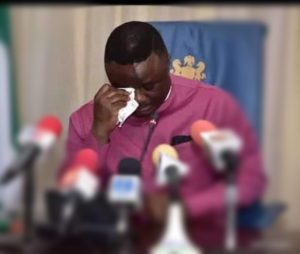
The photograph is difficult to look away from. A man in a magenta tunic sits at a press table, head bowed, tissue pressed to his eyes. Microphones from different media stations crowd the frame. Behind him is the muted blue of a government backdrop with the faint outline of Nigeria’s coat of arms.
The image circulated widely, when former Cross River State governor, Ben Ayade, broke down and wept comical tears, attempting to hoodwink Cross Riverians into believing that he has capacity to grieve with them. The picture itself has already entered the political bloodstream of Cross River and points to his countless attempts to bamboozle the polity while he relentlessly dipped his hand in our collective till.
But so that we may be notified, in politics, men weep at microphones when allies have gone quiet, when the center has shifted, and when the script has changed without their consent. Ayade’s tears foreran his political amputation. To understand how he arrived at this moment, you have to trace the arc.
Ayade came to power in 2015 as a professor with a new language. He promised to industrialize Cross River and spoke of a superhighway, a deep seaport, a garment factory, and a rice city. His emergence owed everything to the PDP structure of then-governor Liyel Imoke. He was the beneficiary of zoning, goodwill, and a godfather’s hand. For a while the brand worked. He was the “digital governor” in a civil-service state, and the future seemed to be his to announce.
The first major break came in 2021 when he defected to the APC. His camp said it was strategy, a way to bring Cross River closer to the federal center. The PDP family that made him saw it differently. They called it betrayal. Defection is not unusual in Nigerian politics, but the manner of his exit and the words that followed created a wound that never healed. He took the office with him, but he did not take the whole base. A quiet opposition began to form inside his new house.
The second break was in 2023. As a sitting governor, Ayade contested the Cross River North senatorial seat and lost to PDP’s Jarigbe Agom Jarigbe. In Nigerian politics, that kind of loss is more than numbers. It is a message. It tells Abuja that you cannot deliver your own zone. For a presidency that trades in political capital, that result became Ayade’s audit report. From that point, Jarigbe began to emerge as the new center of gravity in the North. To many there, he became the “matchless and chosen one,” the man now called the father of empathy and compassion. Titles aside, the political reality shifted. The structure Ayade built started answering to another name.
The third break happened after he left office. Every former governor wants influence over his successor. Governor Bassey Otu, however, moved early to establish his own authority. Appointments changed, the tone of government changed, and the party machinery realigned. Attempts by Ayade’s loyalists to retain control were interpreted by Otu’s camp as an effort to foist authority on a new administration. The result was predictable. The new governor closed ranks without him. Commissioners, aides, and local leaders who once chanted “Food on the Table” found new tables. A structure that cannot hold its home state cannot claim to be a structure.
Through all of this ran a stream of public allegations. Critics spoke of “government by MoU” and projects that lived more on billboards than on the ground. Petitions about financial management circulated, though none have ended in conviction. Ayade’s supporters argue that he was a visionary slowed by lean federal allocations and the shock of COVID-19. The law says allegations are not guilt. Politics says perception is punishment. The words “greed and corruption” attached themselves to his name in public talk, and once that happens, moral capital becomes hard to spend when you need it most.
So was this his fault, or is destiny responding to his own albatross? Politics rarely allows a clean separation. Fault lives in the choices. Breaking with Imoke without taking the full base with him. Underestimating Jarigbe’s hold on the North in 2023. Believing that federal alignment could replace local acceptance. Trying to steer a successor who had his own mandate. Each decision narrowed his room. Fate, if we call it that, is simply the machinery that turns choices into consequences. Lose your senatorial base and the presidency has little reason to invest in you. Fight your successor and the state party will isolate you. Carry unresolved public questions and your opponents will write your biography for you. In that sense, Jarigbe did become his albatross. Not out of personal malice, but out of political math. Jarigbe won the seat, kept it through the courts, and took the title of political leader in the North. In this game, the man who takes your base takes your voice.
If it is true that the presidency asked him to step down from a Senate race, the meaning is clear. Presidencies do not make such requests of men they still need. They make them when a man’s ambition is now seen as a problem for party balance or for a deal with stronger forces. Tears at that moment are not just personal grief. They are the public funeral of relevance. And if the report is not true, the image still speaks, because isolation has its own language. When former governors cry at microphones, it is often because the microphones are all that is left.
There is a school of thought that says Ayade should now plead for mercy from God and recognize that Jarigbe is his master in the game of politics. The language is blunt, but it points to a reality of power. The field in Cross River North has a new general. Politics rewards humility not as morality, but as method. To come down from the high horse is to see the ground again. It is to stoop low to conquer once more, if conquering is still on the table. It is not too late to realize that humility pays better dividends than defiance. But the path back has conditions. Apologize where bridges were burned. Serve without title to rebuild trust. Accept the new hierarchy in his base. Without peace with Jarigbe, no door in Abuja will open with confidence.
For now, the political leader evidently recognized in his base is Maverick Senator Leonard Jarigbe Agom. That is the fact on the ground. Cross River has moved on. The APC in the state orbits around Otu. The North orbits around Jarigbe. Ayade, without a Senate seat, without the governor’s backing, and without the presidency’s ear, is left with memory and media.
Call it fault. Call it fate. Call it an albatross. The outcome is the same. A man who rose with the help of others, broke with them, and then lost the battles that matter, now watches from the margins as the state reorganizes. The structure has thinned. The audience has shifted. The tears, whether from frustration, regret, or realization, mark the point where a man meets the sum of his trajectory.
History will decide if this is an ending or an intermission. Today, the microphone that once carried commands has become a witness to loss. And the room, as always, has moved on.
Agi, (FCA), a public affairs commentator, writes from Ijegu-Ojor, Yala LGA.


