
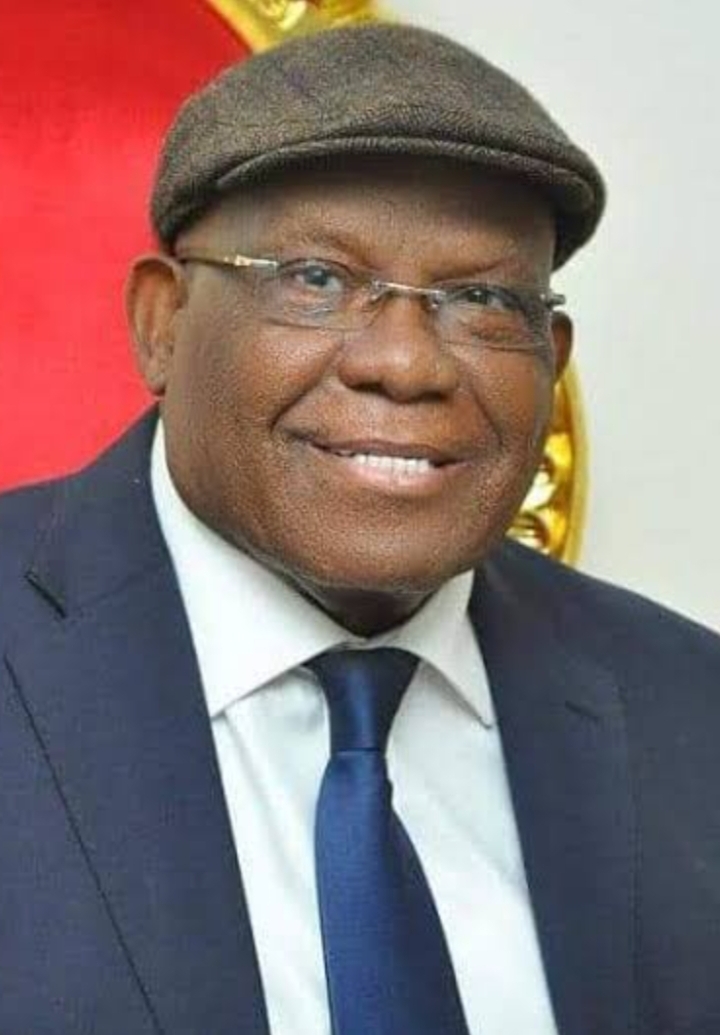








By Iheke Solomon

This man, Ben Ayade,is truly deluded and conceited to be appealing to the Most High for justice in his favour, and totally oblivious of the abbatros on his neck for his eight years of total ‘darkness’ over Cross River. Truly power corrupts. He is disconcerted and finds no true peace outside the corridors of power.
So insecured, flustered, agitated, confused, nervous, and or embarrassed, typically by the pressures of his abysmal failure, and the unmasking of his massive fraud or looting of the treasury of Cross River State.
Stripped of the illusion of permanence like ” This Season’s daffodil” in Rudyard Kipling epic poem “Cities,Thrones And Powers” , Ayade will now realize the vain show of ephemeral power without any concrete positive legacy.
It’s fitting for all those who are in power or are seeking power at any level of societal operations, and in whatever endeavours to read this didactic poem and guard against the mistakes of the political Professor of bombastic English grammar of no substantive depth.
”Cities and Thrones and Powers
Stand in Time’s eye,
Almost as long as flowers,
Which daily die:
But, as new buds put forth
To glad new men,
Out of the spent and unconsidered Earth,
The Cities rise again.
This season’s Daffodil,
She never hears
What change, what chance, what chill,
Cut down last year’s;
But with bold countenance,
And knowledge small,
Esteems her seven days’ continuance
To be perpetual.
So Time that is o’er-kind
To all that be,
Ordains us e’en as blind,
As bold as she:
That in our very death,
And burial sure,
Shadow to shadow, well persuaded, saith,
“See how our works endure!”
Rudyard Kipling 1913 poem is an epigram that offers a philosophical paradoxical and or satirical twist of power in all it’s most alluring and corruptive forms. It urges a meditative, and humbling perspective for political leaders, and other power brokers at every level of their operations, to recognize the fragility of their positions and the cyclical nature of the judgment of history. It constitutes a timely warning to leaders and those seeking to lead, against arrogance, and the need to recognize that that systems and institutions have a natural life span, and require rebirth or transitions that acknowledges change.
The poem in it’s emotive reflection expresses an idea sharply, but often with the humorous diction that donates significant lessons for political leaders. Amongst these lessons are the following:
i. The Recognition of Historical Impermanence :
The institutions of man, including governments, nations, political parties, and or other human organizations are not eternal. They are liken to flowers that “daily die”. Accordingly, Leaders should avoid arrogance, recognize that their power is temporary, and build systems and institutions designed to adapt or evolve to transit gracefully, rather than trying to cling on to or foist themselves to the corruptive alluring nature of absolute power.
ii. The Recognition of the Cyclical Nature of Politics:
Kipling, using symbolic language that, out of “spent and unconsidered Earth / The Cities rise again”, he highlights that failure is not final, and success is not absolute. Therefore a leader should focus on long-term resilience and regeneration, knowing that new leaders, systems and institutions will inevitably evolve, transit and or replace him.
iii. Act with Humility:
A leader should recognize that most leaders that fail often operate with “knowledge small,” but yet arrogant to themselves power that is “perpetual”. Good leaders must cultivate humility, acknowledging the limits of their personal understanding, and avoiding the vanity of believing that they have perfected the act of governance, and are therefore indispensable. That is a lie, and it’s utterly self-deception.
iv. Service Over Legacy:
Service defines legacy. Good leaders must focus on service delivery, and leave legacy to the judgment of history. Thus while the poem acknowledges that it’s all about “Shadow to shadow” , future generations may claim to maintain the past, but the focus should be on the cycle of renewal or renewing rather than the permanence of a specific ruler’s works. The service that serves future generations is what defines true success and elicits a favourable judgment of history that confers or establishes legacy. Even when the original structure is eventually replaced, the legacy remains inviolable and or unassailable.
v. Awareness of Institutional Complacency :
The poem implies that looking only at the immediate present (the “seven days’ continuance”) is a delusion. Therefore leaders must avoid complacency that abounds in most institutions by anticipating future challenges rather than assuming that the current stability will last forever.
The list of lessons from that poem are not closed as the symbolic language and metaphors cannot be completely explained from whatever perspective anyone may examine them. But suffice it to say that the Nigerian experience, and with particularity to the Ayade syndrome, Nigerian have been most unfortunate with the leaders they have produced. With such an ocean of great talents, Nigeria has never had its best at helm of its affairs.
Since after the first republic, when Awo set leadership standards that has not been surpassed till date, we have been plagued by mediocrity, visionless jokers, political jobbers, gangsters, and a clan of recycled locusts who with knowledge small, esteem their seven days’ continuance to be perpetual. That furnishes the rationale for Ayade’s delusion for the quest for continuance of his relevance in the corridors of power.
Let someone warn Ayade that his cup is full, and he risks the anger of not just his northern senatorial district, but of Cross River State as whole, to have him face the law for the budget funds of eight years of his inglorious reign that he cannot account for. Cross Riverians are armed with the various destinations and havens were their patrimony is being hidden.
On the day of reckoning, even President Tinubu would deny him, and the acclaimed funding of Mr. President’s campaigns would be used against him. That statement alone is sufficient for Mr. president to begin to view Ayade with a new prism, and for being a voluntary confession of his misappropriation of the funds from the Treasury of Cross River State. His statement also amounts to armtwisting and blackmailing the President just to get a return but unmerited favour.
Now, the spirit of error is leading Ayade to more fundamental and incurable errors , more like a desperate King Saul who failed to realize that the spirit of God has departed from him, and that he is being tormented by demonic spirits that will lead him to consult the Witch of Endor for the final declaration of his demise by wrongfully conjuring the spirit of Prophet Samuel. ( 1 Samuel 28 ). Ayade is being served poetic justice for his empty political leadership virtues, and governance malfeasance.
Solomon, Esq. is a Legal Practitioner, a Minister of the Gospel of Christ Jesus, and a Professional Thinker.
The views expressed are entirely the author’s.