







By Akanu Odion PhD.
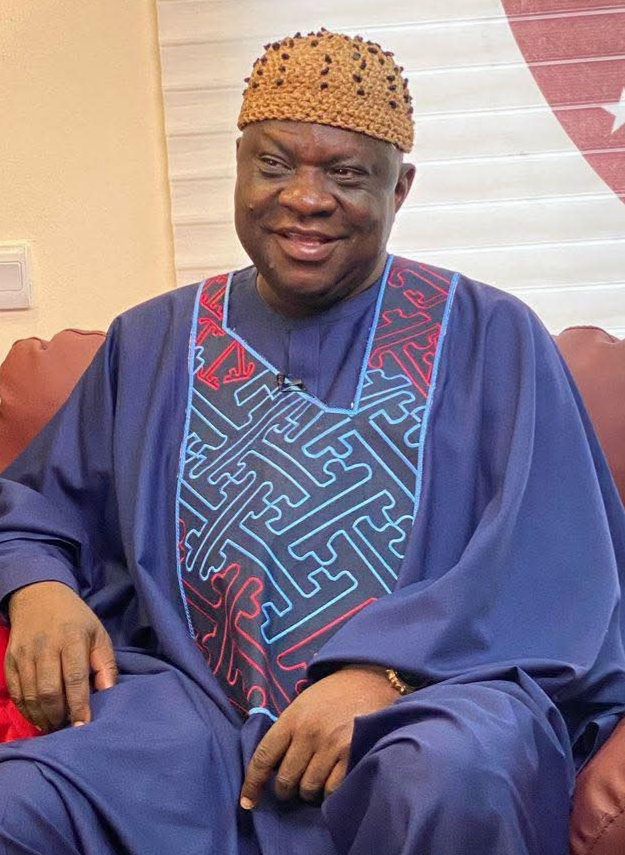
In an age when public office is too often confused with personal grandeur, when the clangor of self-advertisement drowns the quiet music of service, the political persona of Eteng J. Williams, senator representing Cross River Central Senatorial District in Nigeria’s senate, stands as a deliberate contradiction.
Williams represents a school of leadership that is increasingly rare yet eternally relevant: leadership anchored in humility, fortified by competence, and vindicated by measurable achievement. To mistake such humility for weakness is not merely an error of judgment; it is an intellectual failure to understand the anatomy of true power.
Humility, properly understood, is not the abdication of authority, nor is it the timidity of an unsure mind. It is, rather, the disciplined restraint of a leader who understands that institutions outlive individuals and that service, not spectacle, is the true currency of democratic legitimacy. Eteng Williams, exemplifies this higher order of humility, one that coexists seamlessly with decisiveness, strategic clarity, and legislative productivity.
Within a relatively short tenure in the Senate, his record speaks with an eloquence that requires no theatrical amplification. Through focused legislative engagement, effective representation, and an unrelenting commitment to the material interests of Cross River Central, he has demonstrated that influence need not be noisy to be profound. His approach reflects a sophisticated understanding of governance: that progress is often secured in committee rooms rather than camera flashes, in painstaking negotiations rather than populist grandstanding.
What distinguishes Eteng Williams is not merely what he has achieved, but how he has achieved it. In a political culture that frequently rewards belligerence and performative arrogance, he has chosen the more arduous path of civility, intellectual rigor, and consultative leadership. This is not weakness; it is strategic maturity. It is the confidence of a man who does not need to dominate conversations to shape outcomes, who understands that moral authority often outperforms coercive bravado.
Indeed, humility in this context becomes a force multiplier. It disarms unnecessary opposition, builds durable alliances, and engenders trust across political and social divides.
Eteng Williams’ conduct has earned him not only respect within the legislative arena but also credibility among constituents who recognize sincerity when they see it. His politics is not driven by ephemeral popularity but by a long-view philosophy of stewardship, one that privileges institutional strengthening over personal aggrandizement. Those who conflate humility with weakness often subscribe to a crude, almost primitive, theory of power: that volume equals strength and aggression equals effectiveness. History, however, is unkind to such simplistic notions. Enduring leaders, across civilizations and disciplines, have been those who combined firmness of purpose with modesty of demeanor. E. J. Williams belongs unmistakably to this lineage.
As the political horizon bends toward 2027, it is precisely these attributes that position him as a formidable and favored contender for return to the Senate. His achievements provide substance; his humility provides credibility; and his consistency provides reassurance. In an electorate increasingly weary of hollow rhetoric, his record offers a compelling alternative: performance over posturing, results over rancor.
To be clear, Eteng J. Williams is not underestimated because he is humble; he is underestimated only by those who mistake noise for knowledge. His humility is not an absence of strength but its refinement. It is the calm confidence of a leader secure in purpose, anchored in values, and validated by outcomes. In the final analysis, humility is not weakness. In Eteng Williams, it is strategy, it is substance, and it is strength, quietly formidable, intellectually grounded, and politically enduring.
Yet, beyond the immediate contours of his legislative record lies a deeper philosophical coherence that merits sustained reflection. Williams’ humility is not performative modesty nor a calculated public relations posture; it is a governing ethic. It reveals a leader who understands the distinction between power as domination and power as responsibility. In this sense, humility becomes not a personality trait but a mode of governance, one that resists the temptations of ego and centers the collective good.
In many developing democracies, including Nigeria’s, the tragedy of leadership has often been the conflation of authority with infallibility. Public officeholders are frequently encouraged, by sycophancy and weak institutions, to believe that loudness is leadership and that visibility is virtue. Williams’ example quietly subverts this dangerous illusion. His style affirms that listening can be as consequential as speaking, and that restraint can be more transformative than excess. This orientation has practical consequences – a humble legislator is more likely to consult widely, to interrogate policy assumptions, and to appreciate the lived realities of constituents. Such a leader understands that governance is not an abstract exercise but a human enterprise, requiring empathy as much as expertise. Williams’ approach reflects this sensibility, situating policy within context and aligning legislative priorities with real social and economic needs.
Moreover, humility enhances institutional trust. In an era of democratic skepticism, where citizens increasingly doubt the sincerity of political actors, humility functions as a bridge between the state and the people. It humanizes authority without diminishing it. By refusing the theatrics of power, this senator reinforces the legitimacy of the office he occupies, reminding citizens that representation is a duty, before it is a privilege.
It is also important to note that humility does not preclude ambition; it disciplines it. Williams’ political trajectory suggests a man aware of his capacities but uninterested in self-mythologizing. His ambition is not self-referential but project-oriented, aimed at outcomes rather than applause. This distinction is crucial, for ambition anchored in service is the engine of progress, while ambition anchored in ego is the seed of institutional decay.
In legislative environments often marked by factionalism and antagonism, humility becomes a rare but potent stabilizing force. It allows for dialogue where others choose confrontation, and for compromise where others insist on absolutism. This man’s capacity to navigate such spaces without sacrificing principle, speaks to a refined political intelligence, one that prioritizes results over rancor.
As Cross River Central looks to the future, the value of such leadership cannot be overstated. Development is not achieved through episodic displays of passion alone but through sustained, methodical, and credible engagement with the machinery of governance. Williams’ record suggests an appreciation of this truth, reinforcing the argument that humility, far from being a liability, is an asset in the long arc of public service. Ultimately, the question is not whether humility is compatible with power, but whether power can endure without humility – the evidence of history suggests it cannot. Power devoid of humility corrodes judgment, alienates allies, and erodes legitimacy. Power tempered by humility, on the other hand, matures into authority, respected, resilient, and responsive.
In Eteng J. Williams, we encounter a leadership model that challenges shallow assumptions and invites a more serious conversation about governance. His example reminds us that the most consequential leaders are not always the loudest, and that strength, at its highest expression, often speaks in measured tones. Humility, in this light, is not the shadow of power but its most civilized form.
Odion, wrote in from Abuja, Nigeria’s capital.
The views expressed are entirely the author’s.

